In the last decade the construction of high rise buildings was drastically increased. The city of Frankfurt is an example for the fast development of a high-rise skyline. In the meantime urban planners have reached the 300 metre limit for the high rises. Apart from the socio-economic problems arising with them, the structural engineers have to face the following hurdles concerning the construction and the dynamic behaviour of the buildings.
 The currently available codes for wind loads are designed for buildings
with a maximum height of 200 metres. Appropriate transfer modalities are
missing.
The currently available codes for wind loads are designed for buildings
with a maximum height of 200 metres. Appropriate transfer modalities are
missing.
Strong wind events of the last years, which can be mainly attributed to
the change of the global climate, cause considerable damage to the fronts
of buildings.
The economic pressure exerted by the BOT Project (Build-Operate-Transfer)
leads to the construction of more and more slim buildings. These extremely
slim towers are exposed to huge wind loads, which cause considerable vibration
problems.
The mutual dynamic effects of high rises situated closely to each other
are insufficiently studied. Impacts like shielding, which leads to a reduction
of wind loads and the increase of the wind loads through the dynamic part
of the wind, are only basically examined.
Socio-economic
Effects
From the socio-economic
point of view the following problems occurred with high rise buildings:
The building of new high rises in an urban region leads to a dramatic
impact on the wind conditions and on the local climate within a city.
By the so-called "nozzle"-effect between neighbouring high rises, the
wind is strengthened. This leads to:
> noticeable loss of comfort for the pedestrians and
> considerable wind noise.
Problems with the
dynamic behaviour of a structure in slim high rises cause noticeable vibrations.
The latter have a negative influence on the health and quality of life
of people residing and working in such buildings.
Project
Task & Execution
There are no investigations,
which examine the relationship between the structural responses of a structure
and the appropriate wind loads. However, such an investigation is necessary
for the assessment and the development of new standards and regulations
for high rise buildings. This project aims at answering some of these
questions: Several high rises, among them the highest building in Europe,
the Commerzbank, are monitored over a period of 2 years. By the installation
of permanent systems at these high rises, the vibration can be continually
recorded in connection with the wind speeds. These systems deliver dynamic
data, which characterise the structural response of the high rise during
wind events. After the correlation of the two parameters (vibration and
wind speed) and the evaluation of the structural behaviour, detailed statements
on the effect of wind on high rises can be made.
VCE - with its long-standing experience in structural assessment and monitoring - carries out this project, in partnership with the Darmstadt University of Technology (Institute of Concrete Structures and Materials). This Institute recently joined the network as a new "member" and is an expert in the field of high rise buildings. (http://www.tu-darmstadt.de)
The
Examined Objects
The first two buildings,
which are instrumented, are the Commerzbank with a height of 259 m and
the Dresdner-Bank with a height of 166 m. The method applied is the BRIMOS
approach, developed by VCE. The "BRIMOS-Recorder" used is installed as
high as possible on the buildings. Consequently the point where the measurements
are taken is at a height of approx. 200 m in the case of the Commerzbank
building, and at approx. 166 m in the case of the Dresdner-Bank building.
Some
Details
The
recorder is a small box including a vibration sensor, the acquisition
and storage unit, a GPS-system and a modem. In the following please find
some details on the equipment used:
The sensor is a three-dimensional
accelerometer that notices vibrations up to 1/1,000,000,000 g (g=earth
gravitation) and in a frequency range between 0.1 Hz and 50 Hz.
The acquisition and storage unit continuously measures and starts to record
the data stream when a given threshold-trigger is reached.
The GPS-system is used for time correlation. The update interval is one
hour so in fact there is no relevant time drift.
A PCMCIA-modem allows
getting the data via telecommunications.
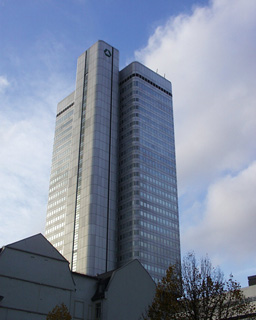
Dresdner
Bank
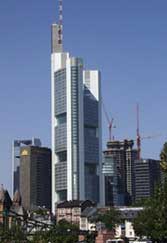
Commerzbank
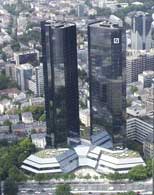
Deutsche Bank
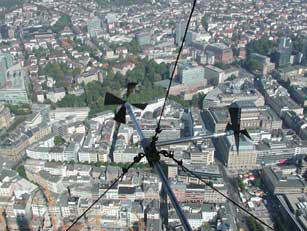
Wind Measurement
Helmut
Wenzel
Vienna Consulting Engineers - VCE Holding GmbH
vce@atnet.at
Carl-Alexander
Graubner
Darmstadt University of Technology
Institute for Concrete Structures and Materials